

For importers, distributors, wholesalers, foodservice companies and international poultry traders, understanding what is the wholesale price of Grade A frozen chicken paws is an important part of planning a profitable purchase.
However, there is no single worldwide price for Grade A frozen chicken paws. The actual wholesale quotation depends on origin, product specification, quality grade, size, cleaning standard, packaging, quantity, season, shipping route, destination port, Incoterms and market conditions.
A buyer ordering a small quantity for local distribution may receive a very different price from an importer purchasing several reefer containers.
This makes supplier comparison particularly important.
Buyers researching frozen poultry products can begin with Chicken Paws Brazil, which provides information focused on frozen chicken paws, chicken feet and other frozen meat products.
This guide explains how international buyers can compare Grade A frozen chicken paws, evaluate wholesale prices, inspect packaging and quality, identify reliable suppliers, calculate landed costs and understand the basic process of importing frozen poultry internationally.
What Is the Wholesale Price of Grade A Frozen Chicken Paws?
The wholesale price of Grade A frozen chicken paws varies according to the exact specification and commercial terms.
A supplier may quote pricing based on:
- Kilogram
- Metric ton
- Carton
- Pallet
- Reefer container
- FOB
- CFR
- CIF
Therefore, buyers should never compare two prices without first checking whether the products and delivery terms are equivalent.
For example, Supplier A may offer a lower FOB price while Supplier B offers a higher CIF price. Supplier B may ultimately be cheaper after international freight and insurance are considered.
For large-volume purchasing, the most useful calculation is usually:
Total product value ÷ total metric tons = product cost per metric ton
The buyer can then calculate:
Total landed cost ÷ total metric tons = landed cost per metric ton
The exact price should be requested directly from exporters based on the buyer’s required Grade A specification, quantity and destination.
Why Grade A chicken paws can command a premium
A higher-grade product may require stricter specifications concerning:
- Appearance
- Cleanliness
- Size
- Skin condition
- Processing
- Defects
- Foreign material
- Freezing
- Packaging
- Handling
The buyer should therefore ask what the supplier specifically means by Grade A.
There is no universal assumption that every supplier’s “Grade A” specification is identical.
What Does Grade A Frozen Chicken Paws Mean?
The term Grade A is frequently used commercially to describe a higher-quality product, but the exact definition can vary by supplier, country and destination market.
International buyers should request a written specification rather than relying on the grade name alone.
A Grade A specification may address characteristics such as:
- Clean appearance
- Proper processing
- Appropriate size
- Limited bruising
- Limited discoloration
- Low defect rate
- No unacceptable foreign material
- Proper freezing
- Suitable export packaging
The buyer should request the supplier’s product specification before signing the purchase contract.
Ask for measurable specifications
Instead of simply asking:
“Do you have Grade A chicken paws?”
ask:
- What is the size range?
- What is the average weight?
- What is the permitted defect percentage?
- Are nails removed?
- How are the paws cleaned?
- Is the product individually frozen or block frozen?
- What is the glazing specification?
- What is the net weight per carton?
- What is the gross weight?
- What is the storage requirement?
- What is the shelf-life specification?
These questions make supplier comparisons much more reliable.
Bulk Frozen Chicken Feet: How to Compare Suppliers, Prices, Grades and Packaging
Buying frozen chicken feet in bulk requires more than finding the lowest price.
A professional importer should compare at least five major categories:
- Supplier reliability
- Product quality
- Commercial price
- Packaging
- Export and import documentation
Supplier reliability
Check whether the supplier can provide:
- Legal company information
- Processing establishment details
- Export documentation
- Product specifications
- Production information
- Shipment history
- Commercial references where appropriate
- Destination-market eligibility
Brazilian poultry buyers researching suppliers can review information from Aurora Alimentos, Coopavel, Vibra Agroindustrial, Bello Alimentos, Lar Cooperativa Agroindustrial and Zanchetta Alimentos.
These resources can help buyers conduct initial supplier research, but importers should independently confirm current product availability, export eligibility and destination-country requirements before placing an order. What is the wholesale price of Grade A frozen chicken paws
How to Compare Frozen Chicken Feet Wholesale Prices
Price comparison becomes much easier when every supplier receives the same RFQ.
For example, provide all suppliers with:
Product: Grade A frozen chicken paws
Origin: Preferred country or open to approved origins
Quantity: Required metric tons or containers
Packaging: Required carton configuration
Destination: Exact destination port
Incoterm: FOB/CFR/CIF
Shipment period: Required shipping window
Documents: Required export and import documents
Specification: Size, cleaning and quality requirements
Then compare the responses.
Example supplier comparison
| Factor | Supplier A | Supplier B | Supplier C |
|---|---|---|---|
| Product grade | Grade A | Grade A | Grade A |
| Origin | Confirmed | Confirmed | Confirmed |
| Price basis | FOB | CFR | CIF |
| Carton size | Confirmed | Confirmed | Confirmed |
| Size specification | Confirmed | Confirmed | Confirmed |
| MOQ | Confirmed | Confirmed | Confirmed |
| Port | Confirmed | Confirmed | Confirmed |
| Documents | Confirmed | Confirmed | Confirmed |
| Inspection | Available | Available | Available |
| Lead time | Confirmed | Confirmed | Confirmed |
This prevents buyers from choosing a supplier based only on the headline price.
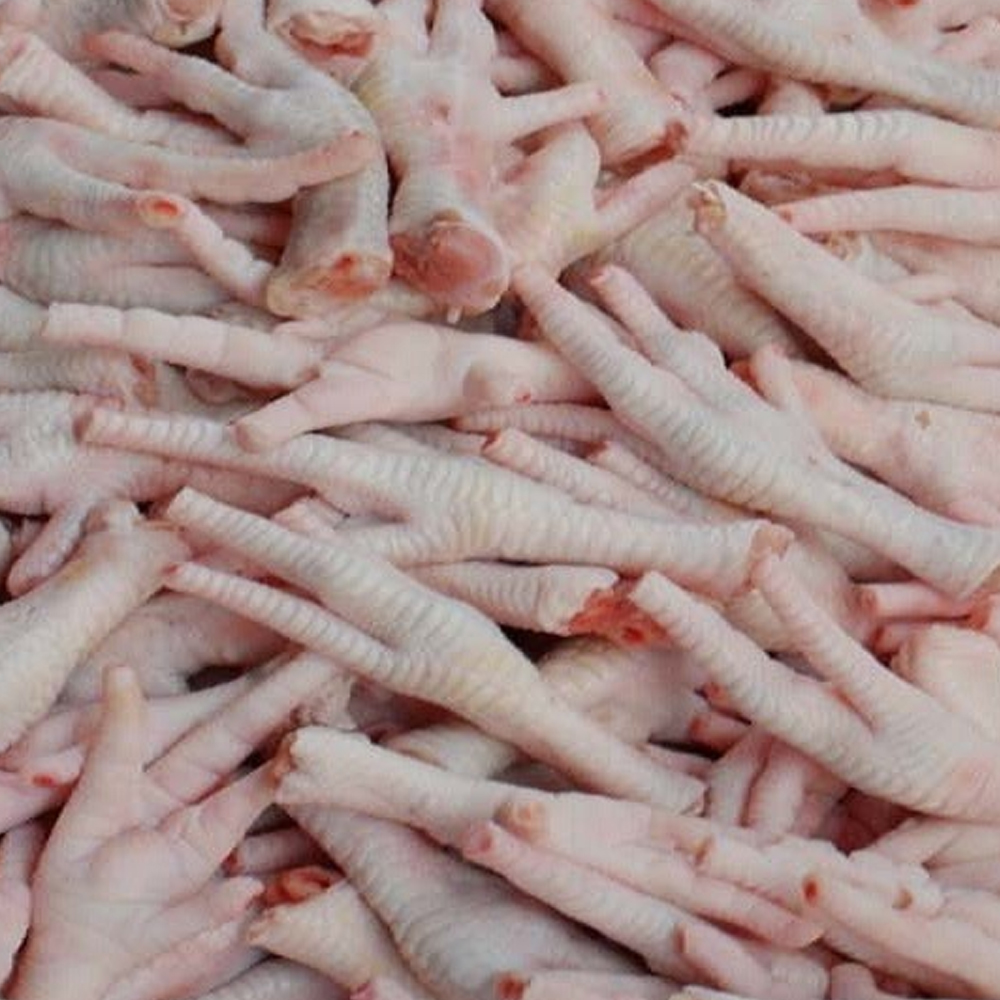
What Is Included in Frozen Chicken Feet Packaging?
Packaging is an important part of international frozen poultry purchasing.
The packaging must protect the product throughout:
Processing → Freezing → Storage → Reefer transportation → Port handling → Customs clearance → Distribution
Depending on the supplier and destination market, frozen chicken feet may be packed in food-grade inner bags and export cartons.
Buyers should confirm:
- Net weight
- Gross weight
- Carton dimensions
- Bags per carton
- Pieces per bag
- Cartons per pallet
- Pallet type
- Carton markings
- Label information
- Production date
- Lot number
- Country of origin
- Establishment information
- Storage instructions
Why carton weight matters
Suppose a buyer orders 20 metric tons and the supplier packs 20 kg net per carton.
20,000 kg ÷ 20 kg = 1,000 cartons
If another supplier packs 15 kg per carton, the same product quantity requires more cartons.
That can affect:
- Warehouse handling
- Pallet configuration
- Container loading
- Labor
- Storage
- Inland transportation
Consequently, packaging should be included in every supplier comparison.
Frozen Chicken Feet vs Frozen Chicken Paws
Buyers should clarify terminology before ordering.
In international trade, “chicken feet” and “chicken paws” can refer to related products, but commercial specifications can differ.
A buyer should therefore provide a detailed product specification.
A typical purchasing request could state:
Product: Frozen chicken paws/feet
Grade: Grade A
Origin: Approved origin
Size: Buyer specification
Cleaning: Export specification
Packaging: Export carton
Net weight: Buyer requirement
Quantity: Container order
Destination: Named port
Incoterm: FOB/CFR/CIF
For product-specific research, buyers can review frozen chicken feet and frozen chicken paws.
How to Find Reliable Frozen Chicken Paws Suppliers
A reliable supplier should be able to provide clear information about the product and the transaction.
1. Verify the legal entity
Check:
- Full company name
- Registered address
- Contact details
- Contracting entity
- Invoice entity
- Bank account information
- Export documentation
The company receiving payment should correspond with the contracting seller unless an alternative arrangement is properly documented and verified.
2. Verify the processing establishment
For animal-origin products, processing establishment information is especially important.
Depending on the destination market, buyers may need to verify:
- Official inspection
- Establishment number
- Export authorization
- Destination approval
- Veterinary requirements
- Health certification
- Food-safety systems
- Halal certification where applicable
3. Confirm destination eligibility
Never assume that an exporter approved for one market is automatically approved for every country.
The importer should verify:
- Country eligibility
- Plant eligibility
- Product eligibility
- Animal-health restrictions
- Import permits
- Labeling requirements
- Veterinary requirements
Chicken Feet and Paws Import Guide: How to Buy Frozen Poultry Products Internationally
Importing frozen poultry requires coordination between the supplier, importer, freight provider, customs broker and relevant authorities.
A basic process is:
Step 1: Research the market
Before buying, understand:
- Local demand
- Wholesale price
- Retail price
- Import competition
- Customer preferences
- Storage costs
- Import taxes
- Distribution margins
Step 2: Find qualified suppliers
Request quotations from several exporters.
Step 3: Define the specification
Confirm:
- Grade
- Size
- Cleaning
- Packaging
- Net weight
- Freezing
- Shelf life
- Labeling
Step 4: Verify import requirements
Check destination-country rules before making a financial commitment.
Step 5: Compare quotations
Normalize pricing to the same Incoterm.
Step 6: Confirm payment terms
Agree on:
- Deposit requirements
- Balance payment
- Payment method
- Banking details
- Contract terms
Step 7: Confirm shipping
Agree on:
- Port of loading
- Destination port
- Reefer container
- Shipment schedule
- Required temperature conditions
- Shipping documentation
Step 8: Inspect if required
For first-time transactions, buyers may consider an independent inspection before loading.
Step 9: Clear the shipment
The importer or customs broker handles destination procedures according to local requirements.
How Much Frozen Chicken Feet Can Be Ordered in Bulk?
The quantity depends on the buyer’s business and logistics capacity.
Orders may be arranged by:
- Carton
- Pallet
- Metric ton
- Reefer container
- Multiple containers
For container orders, the supplier should provide a packing plan.
Important variables include:
- Container type
- Maximum payload
- Carton size
- Carton weight
- Palletization
- Product density
- Destination road restrictions
- Shipping line requirements
Never assume that a particular number of metric tons will fit into every reefer container.
Ask the exporter for:
Cartons + net weight + gross weight + pallet quantity + container loading plan.
Frozen Chicken Feet Quality Inspection
For a large purchase, buyers should establish quality requirements before production or loading.
Appearance
The product should conform to the agreed specification.
Cleanliness
The supplier should meet the agreed processing and cleaning requirements.
Physical condition
Check for excessive:
- Bruising
- Broken pieces
- Discoloration
- Skin damage
- Foreign material
Freezing
The product should remain within the agreed frozen storage and transportation conditions.
Glazing
If the product is glazed, confirm the agreed glazing percentage because excessive glaze can affect the relationship between gross product weight and actual product weight.
Packaging
Cartons and inner bags should be intact and appropriately labeled.
Frozen Chicken Feet Wholesale Price: FOB, CFR and CIF
International buyers should understand the pricing basis.
FOB
FOB pricing generally covers the seller’s obligations up to the agreed point under the applicable Incoterms. The buyer typically arranges the main international freight.
CFR
CFR generally includes cost and freight to the named destination port, with insurance handled separately.
CIF
CIF generally includes cost, insurance and freight to the named destination port, subject to the exact contract and applicable Incoterms.
Therefore, if one supplier quotes:
US$X per metric ton FOB
and another quotes:
US$Y per metric ton CIF
the buyer cannot determine which is cheaper until the additional costs are calculated.
How to Calculate Frozen Chicken Feet Landed Cost
Use this formula:
Landed cost = Product + Freight + Insurance + Duties/Taxes + Port Charges + Clearance + Inland Transportation + Other Costs
Then:
Landed cost per metric ton = Total landed cost ÷ Metric Tons
For example, suppose a buyer has:
- Product: US$20,000
- Freight: US$4,000
- Insurance: US$200
- Destination costs: US$2,000
Total:
US$26,200
For 20 metric tons:
US$26,200 ÷ 20 = US$1,310 per metric ton
This is only an illustrative calculation. Actual prices and costs must be obtained for the buyer’s specific shipment.
What Documents Are Needed to Import Frozen Chicken Paws?
Documentation depends on the origin and destination.
Potential documents include:
- Commercial invoice
- Packing list
- Bill of lading
- Certificate of origin
- Veterinary certificate
- Health certificate
- Export documents
- Import permit
- Product specification
- Inspection certificate
- Insurance documentation where applicable
The importer should confirm the exact requirements with the competent authorities in the destination country and with a qualified customs broker.
How to Choose a Brazilian Frozen Chicken Supplier
Brazil is an important poultry-producing and exporting country, making it a market that many international buyers investigate.
Potential supplier research sources include Aurora Alimentos, Coopavel, Vibra Agroindustrial, Bello Alimentos, Lar Cooperativa Agroindustrial and Zanchetta Alimentos.
Buyers should compare suppliers based on the exact product being requested rather than assuming that every company offers identical Grade A chicken paws.
The key questions are:
- Is the product currently available?
- What specification is offered?
- What is the production capacity?
- What is the MOQ?
- What export documentation is available?
- Is the plant eligible for the destination?
- What is the current quotation?
- What is the shipment schedule?
Buying Other Frozen Poultry Products
Importers purchasing chicken paws may also require other poultry products for their wholesale customers.
Possible products include:
Combining products can potentially broaden a distributor’s portfolio, but each product must be checked separately for specifications, availability, labeling and import eligibility.
Expanding From Chicken to Frozen Beef
Some international meat distributors also source beef alongside poultry.
Product categories that may be relevant include:
For distributors, a broader frozen-protein portfolio can create opportunities to serve restaurants, processors, wholesalers and foodservice customers.
However, poultry and beef can have different regulatory, documentation and destination-market requirements. Buyers should therefore evaluate each category separately.
How to Negotiate the Best Frozen Chicken Feet Wholesale Price
The best negotiation begins with a clear specification.
Instead of asking:
“What is your cheapest price?”
send:
We are looking for Grade A frozen chicken paws for container shipment. Please provide your best FOB/CFR/CIF quotation based on our required quantity, specification, packaging and destination port.
Include:
- Required volume
- Product grade
- Size
- Packaging
- Destination
- Incoterm
- Shipment period
- Payment terms
- Documentation requirements
Suppliers can then provide a more accurate commercial offer.
Larger orders
A buyer ordering multiple containers may have greater negotiating leverage than a buyer ordering a small quantity.
However, buyers should not sacrifice product quality or documentation merely to reduce the price.
A slightly higher price from a reliable exporter can be more economical than a low-priced shipment that arrives with quality, documentation or customs problems.
Common Mistakes International Chicken Feet Buyers Make
Buying based only on price
The cheapest offer is not necessarily the cheapest landed cost.
Not defining Grade A
“Grade A” should be supported by a written specification.
Ignoring packaging
Carton size affects container loading and warehouse costs.
Comparing different Incoterms
FOB, CFR and CIF are different commercial bases.
Not checking plant eligibility
Animal-origin products can be subject to strict destination requirements.
Paying before verifying the supplier
Verify company and banking details before making significant payments.
Not requesting a packing list
The buyer needs to understand how the product will be loaded.
Not checking destination regulations
Import requirements should be established before ordering.
Frozen Chicken Paws Supplier Checklist
Before placing an international order, confirm:
- Supplier identity
- Processing establishment
- Product specification
- Grade
- Size
- Cleaning standard
- Packaging
- Net weight
- Gross weight
- Shelf life
- Production date
- Storage requirements
- Price per metric ton
- Incoterm
- Port of loading
- Destination port
- Container configuration
- Freight
- Import duties
- Required permits
- Veterinary documentation
- Inspection requirements
- Payment terms
- Shipment schedule
FAQ: Frozen Chicken Feet Wholesale Price and Importing
What is the wholesale price of Grade A frozen chicken paws?
There is no single fixed international price. The wholesale price depends on origin, grade, size, processing, packaging, order volume, shipping terms, destination and market conditions. Request a current quotation based on your exact specification.
Is Grade A frozen chicken paws more expensive?
It can be, depending on the supplier’s grading system and the specification required. Buyers should compare measurable quality characteristics rather than assuming that the term Grade A has exactly the same meaning everywhere.
How do I buy frozen chicken feet wholesale?
Start by defining your product specification, required quantity, destination and packaging. Then request comparable quotations from several exporters and verify their legal, processing and export credentials.
What is the minimum order for frozen chicken feet?
Minimum order quantities vary by supplier. Some exporters may work primarily with container volumes, while others may offer smaller wholesale quantities. Ask each supplier for its current MOQ.
How many chicken feet are in a metric ton?
The number of individual chicken feet in a metric ton depends on average piece weight. Buyers purchasing by weight should focus on kilograms or metric tons rather than assuming a fixed number of pieces.
How should frozen chicken paws be packaged?
Export packaging commonly involves food-grade inner packaging and outer cartons, but the exact format depends on the supplier and destination. Confirm carton net weight, gross weight, dimensions and labeling before ordering.
What is the difference between FOB and CIF chicken feet pricing?
FOB and CIF are different commercial terms. FOB generally does not include the main international freight to the destination port, while CIF generally includes cost, insurance and freight to the named destination port, subject to the applicable Incoterms and contract.
How do I calculate my real chicken feet import cost?
Add product cost, freight, insurance, duties, taxes, port charges, customs clearance, inland transportation and other applicable costs. Divide the total by the metric tons received.
Can I import frozen chicken feet from Brazil?
Import eligibility depends on the destination country’s regulations, approved origins, processing establishments, product requirements and veterinary conditions. Buyers should verify these requirements before ordering.
Should I request samples before a container order?
For a new supplier, samples or independent inspection can be useful when practical. A large container purchase should be based on a clearly agreed specification.
Can I buy chicken paws and chicken breast from the same supplier?
Potentially, depending on the supplier’s product portfolio, availability and export eligibility. Buyers should verify the specification and destination requirements for each product.
Can frozen chicken feet suppliers also provide beef?
Some suppliers or trading companies may offer multiple frozen meat categories. Beef products such as topside, trimming, tongue and plate can be sourced separately, subject to availability and destination regulations.
Final Guide for International Buyers
The answer to what is the wholesale price of Grade A frozen chicken paws depends on much more than the advertised price per kilogram.
For a serious international buyer, the correct purchasing calculation should include:
Product quality + specification + packaging + quantity + supplier reliability + Incoterm + freight + import costs + documentation + destination eligibility.
The best approach is to send the same detailed RFQ to multiple suppliers, compare equivalent products and calculate the total landed cost.
Buyers researching Brazilian frozen poultry can start with Chicken Paws Brazil and investigate supplier information from Aurora Alimentos, Coopavel, Vibra Agroindustrial, Bello Alimentos, Lar Cooperativa Agroindustrial and Zanchetta Alimentos.
For product research, buyers can also review frozen chicken feet, chicken paws, breast, whole chicken, leg quarters and thighs, as well as selected frozen beef products.
Ultimately, the right supplier is not necessarily the company offering the lowest quotation. It is the exporter that can consistently provide the required Grade A specification, competitive pricing, appropriate packaging, reliable documentation, compliant processing and dependable container delivery.
For wholesalers and distributors building a long-term frozen poultry business, that combination of price, quality and reliability is far more valuable than a low headline quotation.